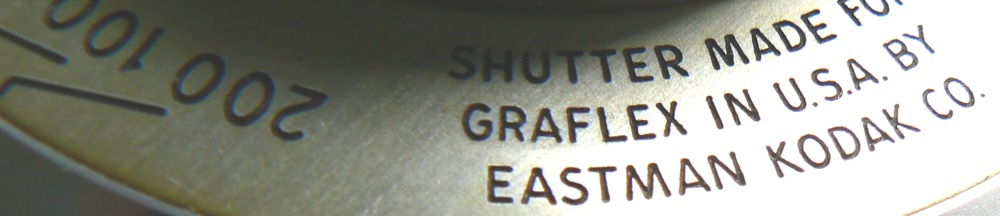
Rapax X Synchromatic
Made by Wollensak
An accurately fitted train of watch gears and pinions, working in connection with a series of levers and carefully tempered springs, assures dependably uniform, properly- timed exposures, the essence of good and well-timed negatives.
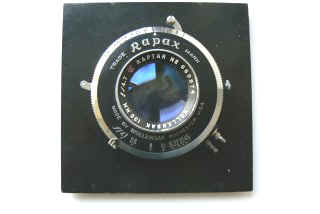
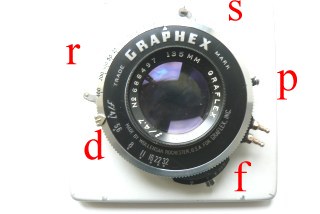
The Rapax and Graphex shutters are
pre-setting type of shutters.
Before exposure can be made, the shutter S
must be
set or "cocked."
This is accomplished by moving the setting lever,
extending from the top of the shutter, to the right, the full length of the slot
in the dust shield attached to the lever.
The shutter is now set and ready for
making the exposure by pressing on the cable release or the release lever r
located on the left hand site of the shutter.
d
= Diaphragm indicator. f
is flash setting indicator. M-F-X and Off.
Attention:
Turn the speed cam- the knurled disk- until the desired speed is opposite the indicating line.
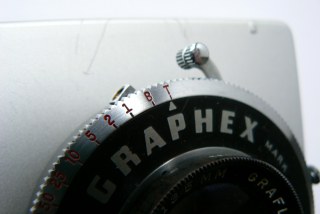
If "T" or Time exposure is used: Set
T on indication line and cock shutter. Release by pressure the lever on the
right hand.
This action will cause the shutter to open and remain open until the
release lever is again tripped to close the blades.
Never reset the shutter
when the blades are open.
Ground glass focusing can be done by cocking
the shutter and depressing the P
Press focus lever clockwise.
This action will open the blades and keep them open
until you have focused.
To close the blades, just lift the Press Focus lever counterclockwise to its original position.
Since the shutter has already been
cocked the shutter is ready for exposing.
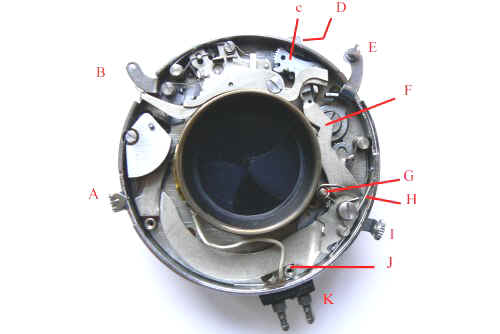
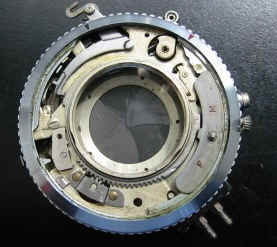
A= Diaphragm Indicator- B=
Release Lever- C= Retarding Device-
D=Cable
Release bearing- E= Cocking Lever- F
=Main Switch-
G= High Speed Spring- H=
Main Spring- I= Press Focus lever- J=Point
of contact- K Connector bi post flash
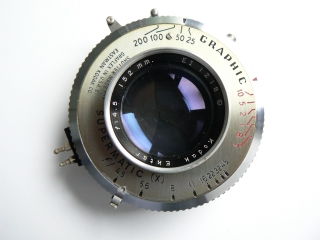
Equipped with the Kodak Ektar f: 4,5 - 152 mm lens, the Kodak Supermatic
(X) is a very nice piece of craftsmanship, mainly because of its simplicity.
The (x) stands for electronic flash.
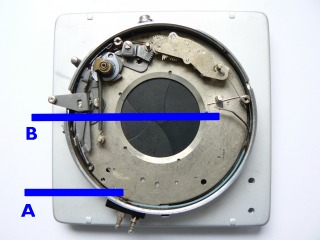
Unlike its predecessor, the Kodak Flash Supermatic, the Kodak Supermatic misses the mechanical delay for M and F bulb
contact, which was situated in the empty space between the A and the B on the photo above.
Now a simple spring wires the "open shutter B " contact with the "A " bi-post flash contact on the outside of the shutter house.
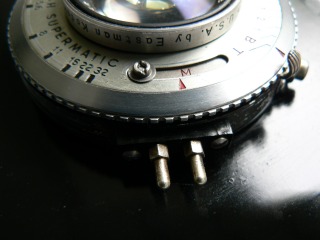
More complicated looks the Flash Supermatic with M and F control for use with (F)ast and (M)edium bulbs.
It is furthermore equipped with the build in self-timer, the press knob and the bi-post flash contacts.

Ektar 107mm f/3.7
Ektar 127mm f/4.7
Ektar 7 1/2 in. f/4.5
Ektar 8 inch f/7.7
Wide Field Ektar 100mm f/6.3
Body diameter 63 mm. Mounting Hole 38 mm. Self timer. No bi-post Flash connectors.
The No. 2 Supermatic shutter (1939~1947) was used on the Miniature Speed Graphic .
The later version is the Supermatic X which has built-in flash synchronization.
Kodak manufactured two other versions of the Supermatic—the No. 1 that has 9 shutter speeds and the
No. 3 that has 8 shutter speeds.
The Supermatic No. 3 is the same shutter as the Supermatic X, but the No. 3 does not have flash synchronization.
Shutter cleaning and Lubrication
The easiest way
Remove both lenses, front and rear.
Drop the shutter into clean white spirit (I’m not sure about the right name. It
is the stuff you remove grease or stains out of cloth)
A sweet tin can would be nice to serve as a bath.
Just a few minutes, wiggle a bit and get it out.
Don’t touch the black blades in the centre of the shutter under no
circumstances.
Lay the shutter on a towel and cock and release the shutter a few times.
Pack the shutter into the towel by winding the towel several times around the
shutter. It’s almost a ball.
Swing the ball having it in the palm of your hand up and down for about one
minute.
Get the shutter out of the towel. Leave it for an hour. From time to time you
may cock and release the shutter setting it at the lower exposure times 1 sec to
1/10.
I’m sure the rim turns easy and the shutter times will do as well.
On the other hand, you washed the oil and grease inside the shutter away, which
means that all the moving parts inside are missing the lubricating.
The consequence is that the shutter will malfunction after some time.
It needs to be lubricated.
To do so, you need to unscrew the screw in the centre of the time exposure
plate.
Turn this plate using two spread fingers with one finger on each side counter
clockwise. About half an inch.
The plate including the rimmed plate must come off now.
It might be necessary to remove the diaphragm index on the side to allow the
plates to come off.
Ektar 152mm f/4.5
Wide Field Ektar 135mm f/6.3 Body diameter 65 mm.
To determine the year of manufacturing
C=1: A=2: M=3: E=4: R=5:O=6: S=7: I=8: T=9: Y=0
EE=1944
Back to Technical Stuff Graflex Cameras Home Jo Lommen Cameras