device to adjust the strength of the spring by its controlling mechanism. The spring power is visible in the window next to the winding wheel. Reducing the strength can be
achieved by pushing the escapement lever to the right.
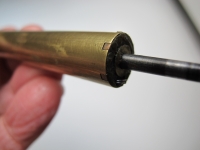
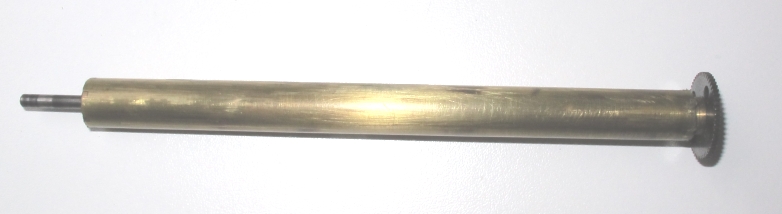
In fact there are two torsion springs inside the tension roller. Both are connected with one end to the middle of the inner shaft and the other end to the left or right of the shaft.
The disc on the left is connected to the left end of the outer shaft. The right disc is connected to the tooth wheel as well as to the outer shaft.
The curtain is glued to the outer shaft while the inner shaft is connected to the shutter wind-and-release mechanics and the other end to the bearing in the camera housing.
Turning the inner shaft with the slotted end turns the middle disc and thus both springs.
Tension increases on both sides of the spring and thus on the tooth wheel which is controlled by the camera release mechanism.

This is a more than 100 years old spring.
After cleaning it presents itself in all its brightness and appears to be ready for the next century.
The inner shaft should be brought under tension (some 8 turns) before connecting it to the wind/release mechanism of the camera.
When winding the shutter, the tension between the outer and inner shaft will be more and more increased by each turn of this action.
The more the shutter will be wound up, the higher the tension will be in order to draw back the outer shaft and thus tearing the curtain with the slit back in its previous start position.
Since both springs are connected in the same way to inner and outer shaft, both are working together towards the same direction!