Mr. William F. Folmer patented some dozen
U.S. patents among which: an Electric Insect Exterminator,
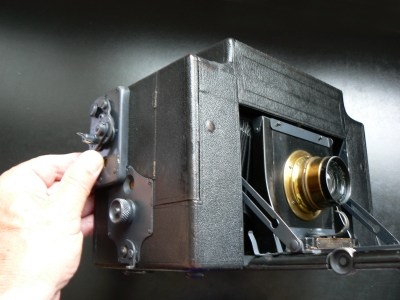
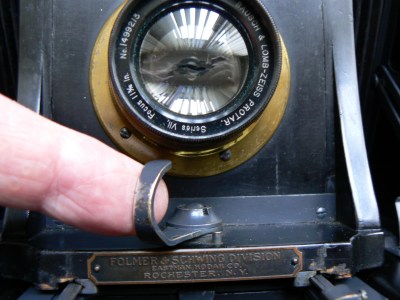
Folmer & Schwing Reflex Camera for 3A Roll film 3¼ x5½ inch or
122 film. W.F. Folmer 's Patent 31 Aug
1900- February 5 -1907 and April 31 1908. From the 1906 Folmer &
Schwing Catalogue 1907-1911
This camera is autographic, uses roll film
and takes postcard sized-3 1/4x 51/2 inches pictures- often
called "standard" size. The fabulous 3A Graflex in perfect
working condition one century after its manufacturing. The 3A Graflex was
manufactured by Folmer & Swing, at that time a
Division of the Eastman Kodak Company. How to open the
Camera. The focusing hood
opens automatically if the top-cover of the camera
is raised. Attention,
Egg Cartons, Ignition Torch for cigar shops, Gas Burner
for Billiard Tables,
Stereoscopes and Film Holders. He was the father of the Folmer
& Swing Graflex Cameras.
Graflex 3A Camera
3 ¼ x 5 ½
Roll Film Reflex Camera

The autographic inscription- date and title or similar
information written on the film at the exposure time-
becomes a permanent part of the negative.
Such a record is invaluable for identifying the scene, long
after the exposure is made.
Amateurs everywhere favour the postcard size picture.
It is large enough to show considerable detail in the
contact print and its proportions are such that both upright
and horizontal subjects fit the image area without waste
space.
When an upright subject is to be photographed lengthwise of
the film, the camera is focused a normal position, then held
on its side when making the exposure.
Sockets are provided so that a tripod may be employed when
making either vertical or horizontal time exposures.
Kodak Film, in 6- or 10-exposure rolls is used.
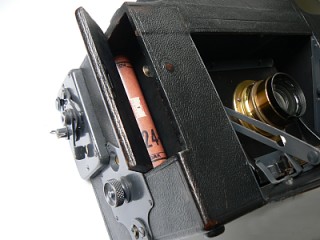
Four extra rolls can be stored in the ends of the camera,
giving it a total capacity of 50 exposures, conveniently
carried.
Twenty-four instantaneous speeds, ranging from 1/ 10 to 1/
1,000 of a second, a slow automatic exposure of about 1/ 5
of a second,
and time exposures of any duration are available with the
focal plane shutter.
Bellows capacity is 10 inches and the front is rigidly built
to accommodate f. 4.5 lenses of 7-inch focal length.
This fits the 3A Graflex for all-around amateur use.
Details Dimensions, 10 x 5 x 6 3/8 inch. ; bellows capacity,
10 inch.; weight, 7 Ibs.; size of lens board, 3 1/4 x 3 1/4
inch. ;
minimum focus of lenses accommodated, 6 ½ inch.
For roll film only. Plate adapters cannot be supplied.
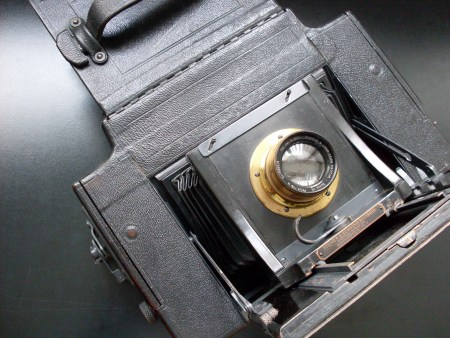
The camera was equipped with a build in Autographic
device which was placed in the back film cover of the
camera.
A window could be opened and made the film paper back
accessible for writing date and location to identify
the scene
long after the exposure was made.
From 1907 until 1926 the Graflex 3A was one of the
first cameras equipped with a reflex mirror.
Such cameras were equipped with a ground-glass on top
of the camera housing on which the lens image via the
surface mirror is projected.
A viewing hood is placed above the ground glass for
better viewing without incoming stray light
The mirror pops up when exposure knob is pressed and
the film is being exposed at the same time.
That means that the focal plane shutter curtain moves
from top to bottom with a horizontal open slit along
the film surface.
The incoming light which enters through the lens
exposes the film during the time that the open slit
passes along the said film surface.
The 3 1/4 x 5 1/2 "standard" size film often called
"postcard" in combination with the mirror reflex
system, became very popular with the press, street
photographers and war correspondents.
If portrait mode must be used, the camera can be
focused in the normal horizontal landscape position,
and then held on its side when making the exposure.
Even in this position there is no light coming in
because of the reliable mirror "home" return.
The curtain is equipped with 4 different sized slits
which made it much more reliable than an adjustable
slit such as many German cameras used to be equipped
with.
The 4 different slits in combination with a 6
different shutter tension roller, made it possible to
choose between 24 exposure time possibilities.
The first 3 A Graflex series distinguish from the
later model only by an offset in the rear of the body
under the film track and the lack of the autographic
feature*.
As mentioned above, the 3A Graflex was equipped with a
so called Autographic
Back which enabled the photographer to write
info on each negative.
All the advantages of a reflex camera, the very
reliable shutter, the rigid construction and the
availability of the 122 film 3 1/4 x 5 1/2,
made it possible that the Graflex 3A camera had a
remarkable long life span of nearly 20 years until
1926.
The construction of this very rigid camera,
which is made from lock jointed mahogany, covered with
Persian Morocco leather
is more or less comparable with the 10 years later
launched
Compact Camera.
Main differences were a third safety curtain and the
lack of both film compartments left and right of the
camera housing.
The Graflex 3 A design created a surplus space on each
side of the camera converted into film storage
pockets, each carrying two rolls of film.
The lower spring loaded roller of the horizontal focal
plane shutter was ingeniously placed under the mirror
case thus reducing the height of the camera house.
Dimensions: 10¼ x 5 x 6 ½ inch. Lens board measures 3
¼ x 3 ¼ inch. Minimum focus of lens accommodated 6 ¼
inch.
The construction of the back does not allow the use of
film holders in any way. Just 122 Roll Film can be
used.
The overall condition of my 100 years old camera
proves that the 3A is all together a solid and very
reliable camera.
The focal plane shutter still works perfectly after
100 years without any repairing, cleaning or
lubrication what so ever.
However, I assume that many of such cameras were not
so lucky and stored away with a fully tensioned
spring, eventual in very bad conditions such as in
moistly cellars of hot attics.
Lock the hood using the side brackets.
On top of the hood, soft velvet shaped to fit the
contour of the face of the photographer
and thus excluding extraneous light, enabling the
operator to focus perfectly.
Now open the front door by pushing the hidden
knob on top of the right film compartment.
The door opens automatically but needs to be
pushed further down until it "clicks"
Pull the lens standard with lens out of the camera
housing until the infinity stop on the end of the
track.
First pull lens out of the camera house against
infinity stop
before setting the controls.

To open the
camera press the hidden knob on top of the
lower left side on top of the camera. (Seen
from the front side of the camera).
The hinged bed door opens automatically. Pull
the bed down until the bed braces snap into
the full locked position.
Swing the front standard lock out straight and
pull the front firmly against the infinity
stops and lock this position by turning the
standard lock to the left.
To open the focusing hood press the spring
catch forward. The hood unfolds automatically,
but you have to lock the two
braces to hold the hood in open
position.
Set the mirror by pressing lever H until it locks. You
may now see an image on the ground glass.
Now turn the focusing knob on the lefts side
of the bed backwards or forwards until the
desired object is sharply defined on the
screen.
For aperture and diaphragm setting see Instantaneous Exposure.
To close the
camera, please be sure that you first press
the mirror lever H until it locks.
Now swing the standard lock straight and
push the standard all the way back into the
camera body.
You may help a bit by pressing the mirror
lever H a bit
more to allow the standard and bellows to
find enough space behind the bed door.
Swing the front standard lock to the left to
lock the standard. Make sure the sliding
track is moved all the way back.
Press down the braces and close the hinged
bed door.

pull lens out of the camera against infinity stop and lock it in that position

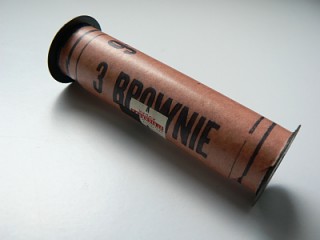
The Film No.
A-122.
The wide body included two compartments
for storage of each two films.

The
hinged cover when opened gives easy
access to the film compartments.
Watch and see the working of the
horizontal slit focal plane shutter
which moves vertical along the film surf
ac e..
On both sides of the camera back you'll
find a blade shaped spring which keeps
the roll film tide on the spool,
which greatly facilitates loading and
unloading the film spool in or out the
camera film compartment.
More info about
the working of the reflex-mirror
in Time modus.

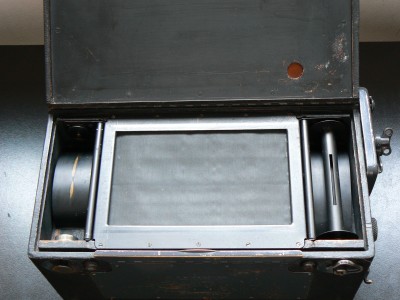
The opened back of the Graflex 3A
shows the mirror house in Time
exposure position.
That means that the mirror in this
situation is flipped up against the
mirror.
No image can be thrown on the ground
glass.
Instant
modus.

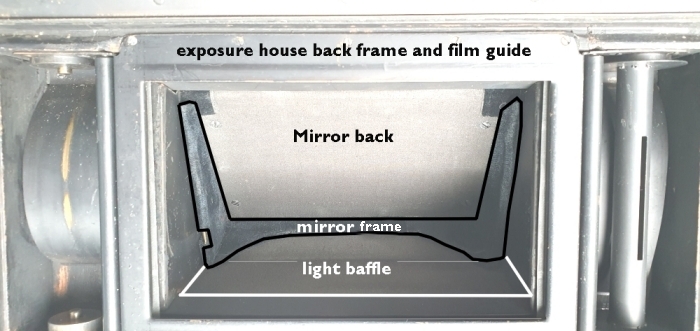
If the mirror
is in down position, thus in Instant
setting, the entire
mirror house behind the mirror is
completely dark
to protect the film for unwanted
light and waiting for exposure by
the release button.
The release catch holds the mirror
in down position until the release
knob will be activated.
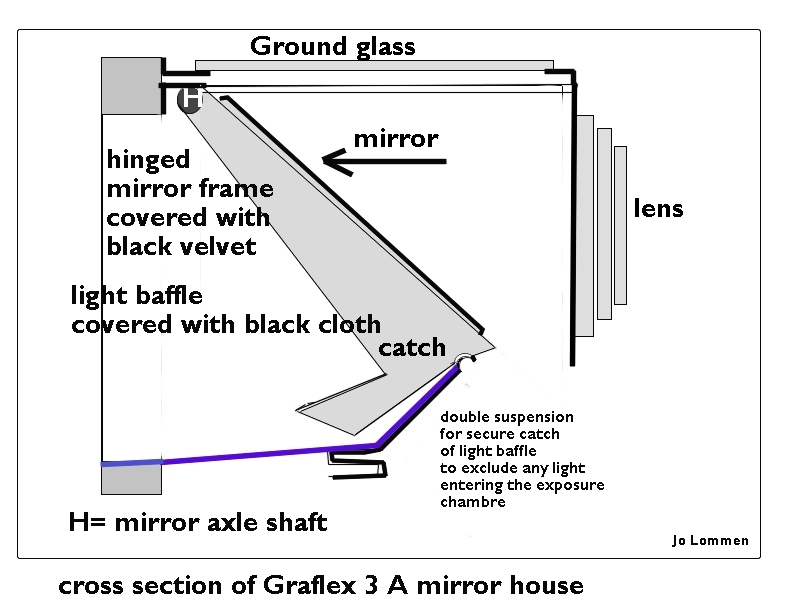
The exposure
chamber
fig 8
Above figure
shows the mirror in 45 degree
focusing position.
Special attention for the double
flexible suspension light baffle.
An identical but single suspension
assembly was used in the Graflex
1-A.

The downwards moving releasing arm
with its slant end 39 moves
the horizontal release arm to the
right.
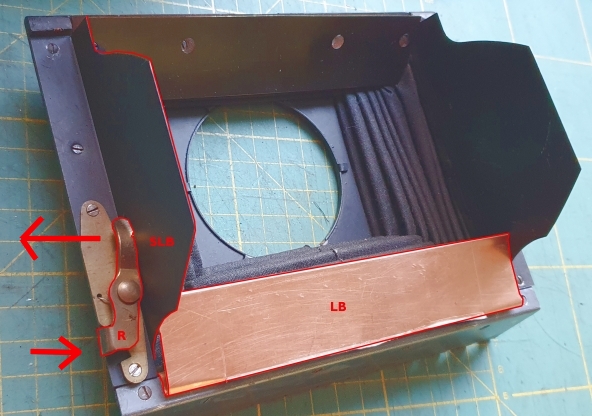
Above the backside of
the lens section including the bellows
and lens plate.
This section houses the hinged mirror
frame with on top the reflex mirror.
LB is a new made light baffle
with on its top the mirror frame
catch. See fig 8
This part replaces a worn and broken
original. The light baffle will later
be covered with black lining.
On the left side the R
thoroughly cleaned release button
assembly. See also Fig 9.
The push arrow moves the release arm
to the right and unlocks the mirror
with catch 27 .
SLB stands for Side Light
Baffle. Once assembled again, these
thin metal shields are situated
between camera wall and exposure
chamber.
Together with the Light Baffle and the
mirror frame, they secure a light
proof exposure chamber.
If the release button is pressed, the
mirror pops up and at the same time
the focal plane shutter
starts its journey along the
film to expose it with its pre-set
slit.
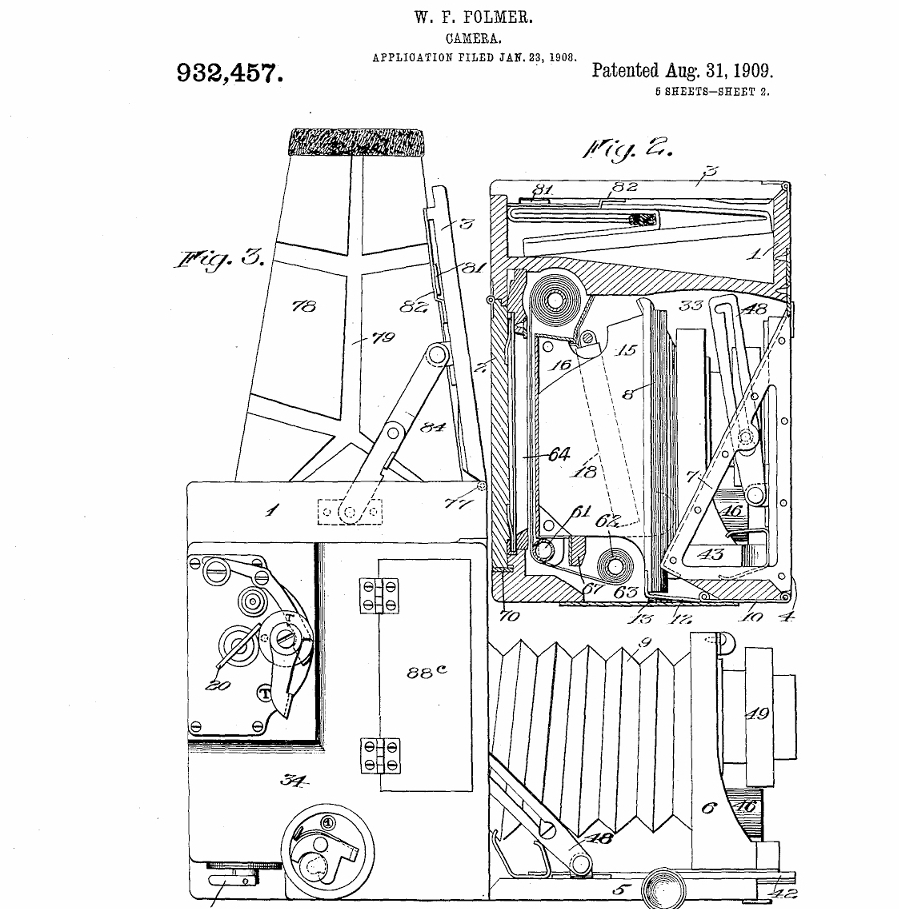
Patent. figure
1 shows camera in open position.
Focusing image on ground glass and
ready to take an exposure.
Red is mirror. Blue is spring.
Improved Mirror Spring
The
later model, the one with the
autographic feature, has a different
mirror spring system than the first
edition like the one here above.
(blue 26).
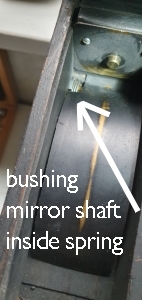
This later type has a shaft bushing
spring visible on the outside of the
left camera side.
Inside the bushing there is a spring
which power holds the mirror up
against the ground glass.

The
big bushing of the mirror shaft
holds the mirror under pressure
while the small bushing holds the
upper curtain roller in position.
Both features are part of the later
produced 3A Graflex model. Visible
inside the film spool storage
pocket.
Enlarged
patent drawing of the Graflex 3 A
camera in closed and open position.
*closed position in coloured upper
right corner.
The 3-A Camera Patented by William F
Folmer is almost
an identical design like the Compact
Graflex, all be it that the 3 A
lacks the safety curtain.
In stead of a third safety blind,
the mirror (17)
combined with the light baffle (68)
keeps the exposure chamber light
tight during the exposure time
setting.
The
Instantaneous Exposure
After the image on the ground glass
is properly focused and the darks
slide of the film holder has been
drawn or removed, the exposure
is made by a downward pressure of
the release lever.
The hinged mirror swings up and at
the same time the focal plane
shutter with the pre-set open slit
moves down along the film surface to
expose.
The
focal plane shutter gives
instantaneous exposures of 1/10 to
1/1000 of a second as well as time
exposures of any duration.
Not forgetting to mention that the
shutter is equipped with a safety
device which prevents winding the
shutter until the mirror is set.
The
focal plane shutter is the very same
as we can find on all the other
Graflex cameras of that time.
Apart from the O = "open" setting
for time exposures, the curtain
contains 4 different slits.
These represents the width of the 4
curtain apertures. The first one is
1½ inch, the second ¾ of an inch the
next 3/8 of an inch and the fastest
aperture is 1/8 of an inch.
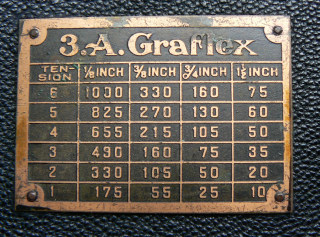
The Graflex Speed table mounted on
the viewing hood shows instantly the
speeds obtained with the different
tensions and the various apertures.
6 spring tensions combined with the
4 openings or slits gives a total of
24 different exposure times.
The narrower the slit which moves
across the film surface, the shorter
the exposure.
Any exposure time you want is
available.
To make
a time exposure: Set the
mirror.
Turn the I-T disk in such a way that
the T
is opposite the mark on H.
In the newer model with the
Autographic, slide the bar to the
marked position T
Now the mirror is no longer
connected to the release.
Turn the winding key until "T" is
visible in the window.
Set tension at least on 4. Now
focus to your subject.
Set the diaphragm. To take
the photo: Raise the mirror by
pressing down the release lever on
the left side.
Now the mirror pops up. By pressing
down the lever M
located on top of the upper control
panel, the curtain is pulled down
and the full opening exposes the
film.
By pressing down the lever again,
the curtain is drawn down, covers
the film and thus ends the
exposure time.
Slow Instantaneous exposure.
Automatic
exposures of approximately one fifth
of a second can be made.
To do this. Set the mirror and
set the curtain at O
(open) and the tension at 5.
Now by pressing the release knob at
the left front side of the camera,
the mirror will rise up and start
the exposure at the same time
allowing the curtain to terminate
the exposure.
The
following lenses were available with
the 3A Camera:
Zeiss Kodak f 6,3 no. 4 - Bausch
& Lomb Zeiss Tessar Series Ic f=
4,5 -
Cooke Lens Series II f=4,5. No. 21
1/2.
Comparing to the camera, the lenses
were very expensive.
The price of the camera without lens
was $ 75.00 lenses from 101.00 for
the Kodak to 125.00 $ each for
the B&L and Cooke
(catalogue 1914)
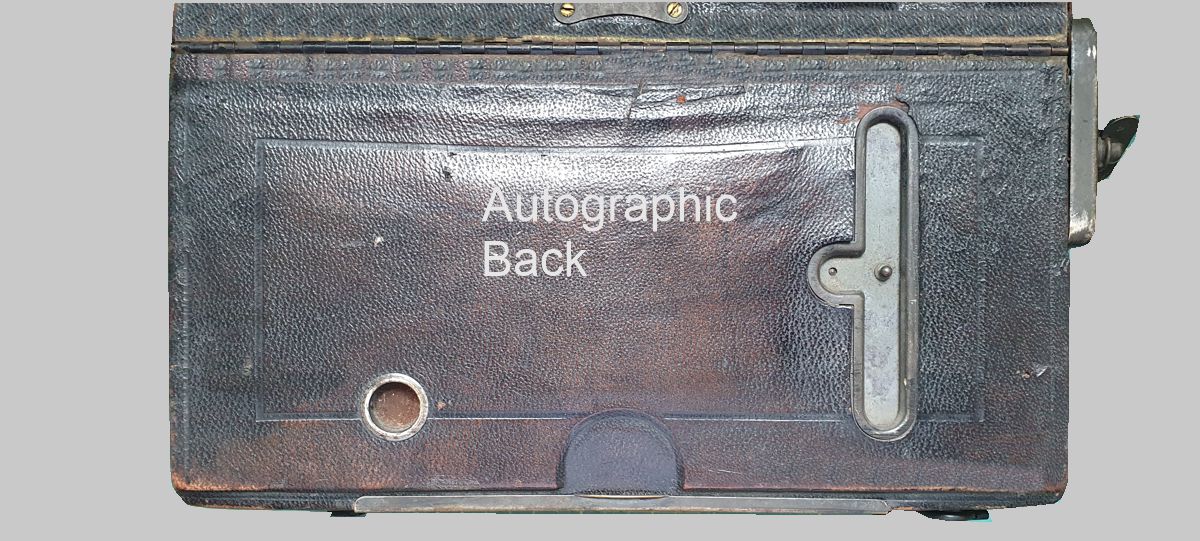
The Graflex Autographic Feature
The
Graflex 3 A back cover is equipped
with the Autographic feature.
This device made it possible to make
notes of the location or event
direct on the negative immediately
after the exposure.
An oval shaped device in the back of
the camera was equipped with a
sliding mechanism which gave access
to the underlying film cover paper.
A small metal stylus, clamped on top
of the camera could be taken out to
use as a pencil.
A sort of typewriter carbon
transferred the written text on the
negative beneath the film cover
paper.
The text was clearly copied and
later visible in white on the
negative.
A Highly Profitable
Contract
George Eastman purchased this
invention from Henry J. Gaisman, a
very successful inventor and
entrepreneur,
and paid him 300.000 US$ for it. Kodak
added this new invention to all its so
called "Autographic" cameras.
From then on all Kodak and Graflex
cameras were equipped with this useful
Autographic feature.
Photos
© Jo Lommen