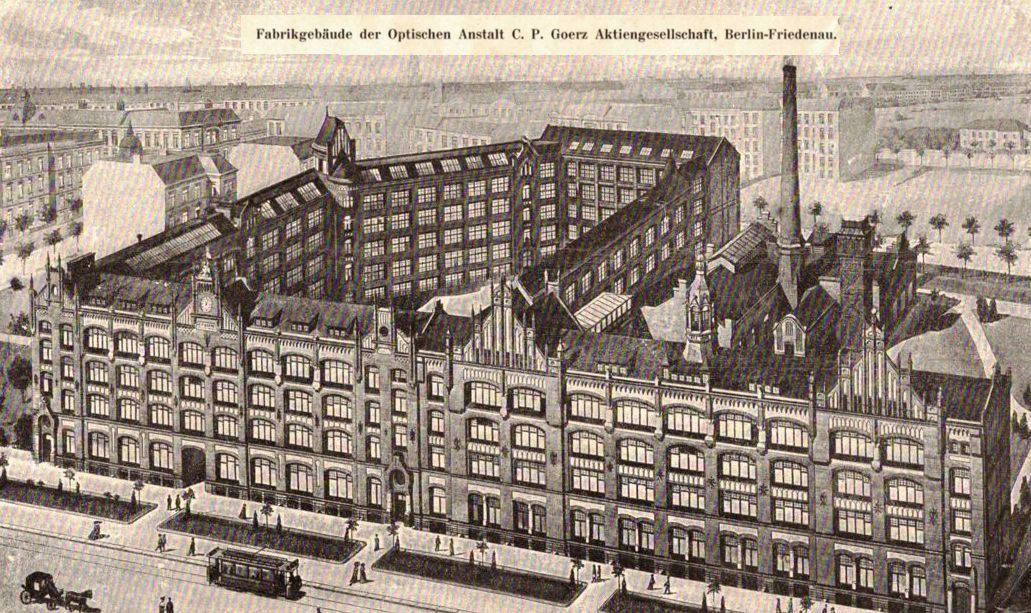
Founded by Carl Paul Goerz 1886 the Company in Berlin was a manufacturer of technical instruments and as from 1888 photo cameras and
lenses. They produced the first Anschütz cameras. These Anschütz cameras which were based upon the Anschütz focal plane shutter principle.
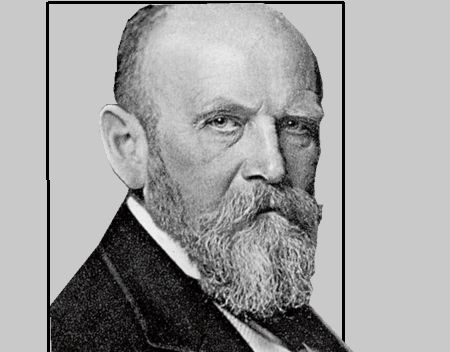
C.P. Goerz the entrepreneur
&
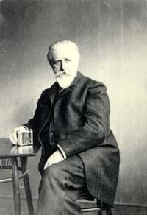
Ottomar Anschütz
The Photographer and inventor
In that function he frequently accompanied the “Kaiser” Wilhelm II and his family on their journeys all over the world.
Beside that he was specialised in taking photos of fast moving animals and sportsmen
and invented the focal plane shutter, allowing him to make use of shutter times possible up to 1/1000 sec.
In the year 1883 he placed 24 cameras in line and made brilliant pictures of the movements of a flying stork as well of a javelin thrower.
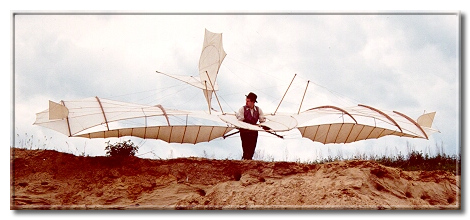
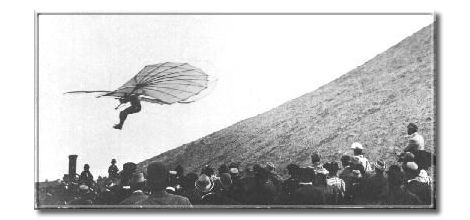
He made himself deserving by photographing Lilienthal’s flying training on the “Fliegeberg” in 1894.
Designing and Manufacturing
of the
GOERZ Anschütz Patent ANGO Camera
"ANGO"
ANschütz + GOerz
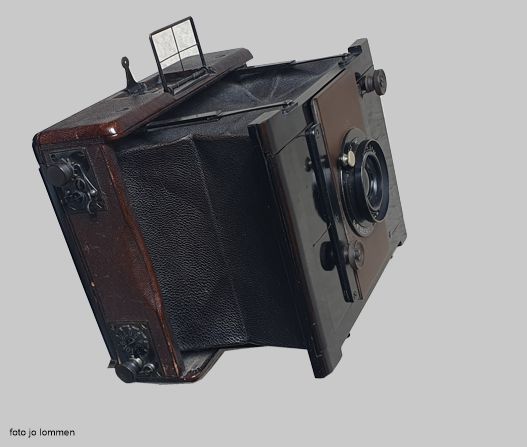
The Goerz Anschuetz strut foldingcamera, introduced in 1896 was equipped with the “Ottomar Anschuetz Patented” focal plane shutter. An 1909 Australian advertisement announced the Goerz Anschuz availability with the actual prices.
Such a camera lacks an "in-between" the lens shutter.
Ottomar Anschütz's invention made it possible to expose the film in a very short shutter time up to 1/1000 of a
second.
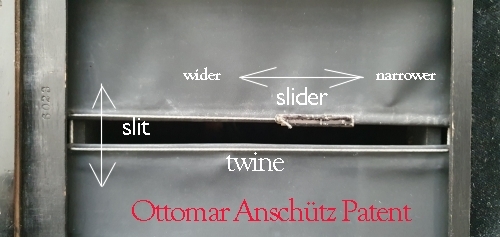
This remarkable shutter exist out of two roller blinds separated by a manual adjustable slit. See explanation here below.
Different exposures times could be obtained by altering the width of the slit in combination with the tension of a spring loaded roller.
The tension of this roller could be increased by the winding key and decreased by
resetting the indicating disk.
However the width of the slit must be set by hand which was a meticulous and time-consuming task
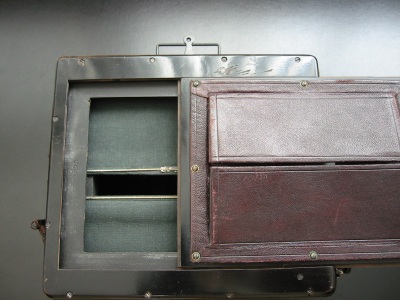
The upper curtain has a moveable metal slider mounted on the upper curtain clip which is connected with a thin twine
to the lower curtain. Sliding the clip to the left would made the slit more wide and moving to the right it would make
the slit narrower.
See the photo below.
During the winding, the slit would stay open. Mind to keep the plate or film holder-dark-slide in the holder to avoid blurring the negative.
thus the faster the curtain will be drawn back in its
home position after the release.
Winding can be done until the procedure automatically will be locked in the end position.
Here it stays locked, waiting for the release of the exposure button.
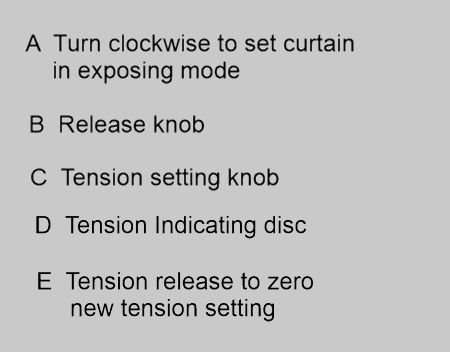
More or les power can be obtained by setting the spring pressure knob.
Instant and Time exposures can be made by switching the knob on top next to the winding knob.
The original upper roller blind shows printed in red, 5 figures representing the slit opening 0,1,2,3,4 and the description
“Ottomar Anschuetz Lissa Preussen.
Lissa was a town in the Prussian province of Posen part of the German Empire until it was returned to Poland in 1920.
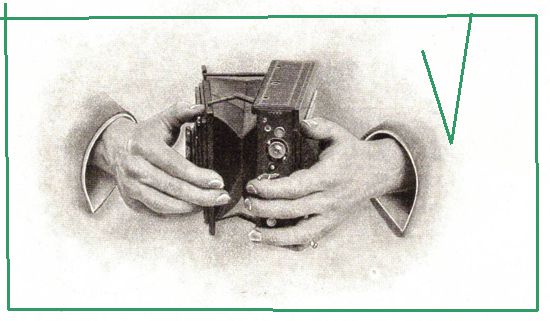
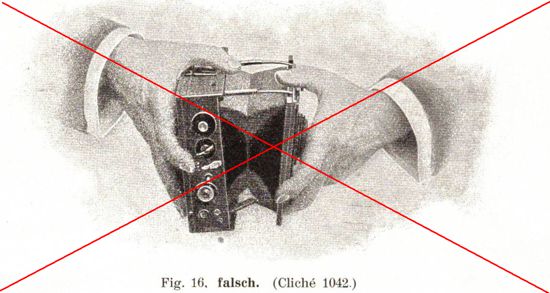
To open the camera please follow this instruction to avoid serious damage.
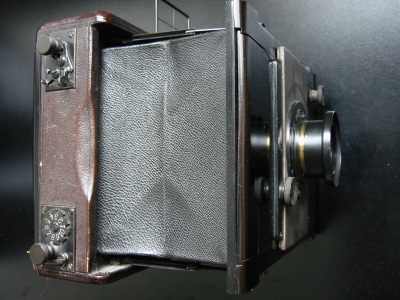
Pull the front on the left side out until the strut construction snaps into position.
Now follow the same procedure with the right side.
Now the front is positioned parallel to the camera back and ready to continue for exposure.

Please think twice before you lay any "focal plane shutter camera"
with the lens pointing upwards to the sun.
As we already learned that these Goerz cameras are equipped with a focal plane shutter and that
such cameras lack an in-between the lens shutter.
That means that the sunbeams can easily penetrate into the camera
house.
The concentrated focused sun beams will definitely burn holes in the focal plane shutter curtain and makes the camera useless.
Infinity means that the focal point lays exactly on the plane fabric. It takes less than a minute for the sun to burn a hole in the precious shutter fabric.
To expose
First set the width by moving the slider along the curtain clip before winding the
shutter.
Then wind the key until it stops.Because the lower curtain cannot move further than the upper edge of the exposure window,
The open slit has been set now inside the housing and as the spring of the lower roller has been loaded during this winding, the slit is
ready to be released
for its journey along the sensitive glass plate, but first the film cassette has to be installed and
locked into the exposure window.
After drawing the cassette's dark slide, the glass plate or film will
be exposed by the open slit passing by.
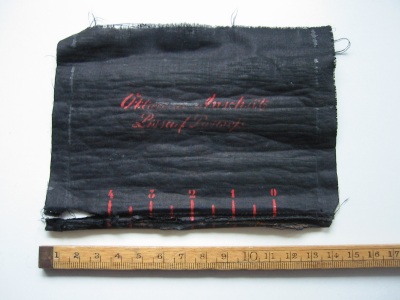
The blinds are made from cloth with a rubber coating to make the curtain light proof.
I suppose that my camera was not used for a period of decades or even longer, as the blinds could not be unwound from the rollers.
I removed the mechanism and peeled off the blinds from the shaft and made new blinds of 100 percent new black out shutter curtain fabric.
Unfortunately I had to sacrifice the stamped original blind.
Renewing both blinds and straps was not a hell of a job.
This is how it works with new focal plane curtains.
The target group
An ideal camera for tourist, travellers, and all wishing a nice high class camera in a compact,light and quickly-adjusted style.
An entirely new model. The speeds of the focal plane shutter working automatically from 1/120 of a second up to 5 seconds
Available in 5 1/2 inch x 3 1/4 inch
Postcard size and 6 1/2 x 4 1/4 inch G-Plate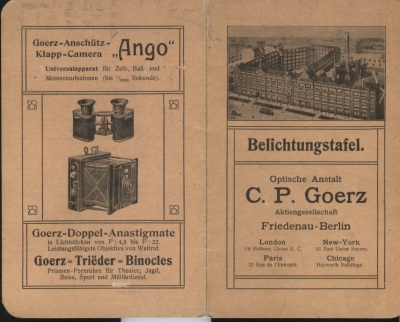
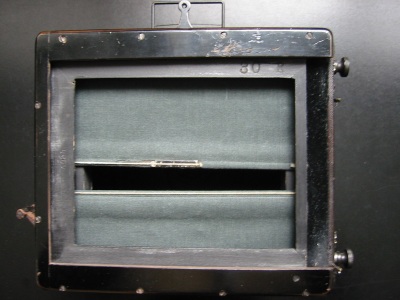
This particular camera is equipped with a Doppel Anastigmat 4,6/120 mm.
The lens-board can be moved up and down and shifted to the left and the right in Portrait Mode, making it possible to apply "Scheimpflug",
the geometric relationship between the orientation of the plane of the object, the lens plane and the image plane.
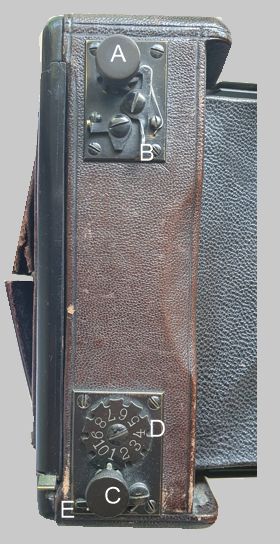
Seen from the back, on the right side on top, we find the winding knob A to cock the shutter in open modus.
So film holder should be closed during
this action.
The knob has to be turned clockwise until it stops automatically.
Now the lower blind covers the whole exposure frame and the preset slit
together
with the upper blind has been positioned on the upper roller.
Ready to be fired. However, another appliance can be set to increase or
lower the speed of the slit passing along the sensitive glass plate.
It is obvious that exposure can only take place after the dark slide has
been drawn from the plate holder.
If not the film remains unexposed. Don't forget to slide the dark-slide back again after exposure.
The spring tension should be set with the lower knob turning it anti-clockwise in 10 steps.
The shutter-speed depends on the speed of the shutter-curtain and the width of the slit between the two roller-blinds.
Turn the winding knob until the slit is visible and set the slider.
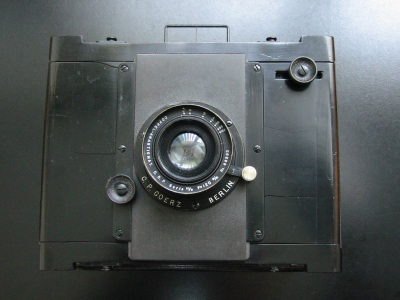
The second generation
The Goerz Anschutz Klappkamera
Model 2
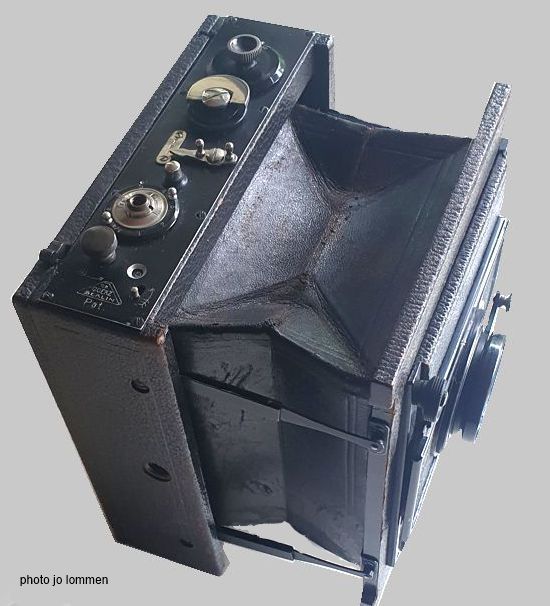
This successor of the above described first Model 1 Goerz camera
was equipped with the mechanic controlled disk setting of the width of the slit.
The camera consists of a frame with a focal-plane shutter, to the rear of which the ground glass screen
is detachably mounted, as well as a bellows and a front standard.
The front standard and rear frame are connected by four scissor-like folding struts.
On the right narrow side of the frame are the external shutter components required for the various operations (see Fig. 1,
camera unfolded, ready for use),
while the threaded bushings for the tripod screw are embedded into the bottom long side and left narrow side.
The viewfinder (Newton finder)is mounted on the top long side.
The camera front standard carries the lens board (made of magnalium) with the lens.
The latter is housed in a focusing helicon (special) mount, as the camera has a fixed extension length.
The Shutter How it works Slit-width setting. Instantaneous exposures (Snapshots). Time Exposures
Set chrome arrow con Zeitor Time and depending on a English or German camera the disc a on 90.
The width of the slit has been set on 90 mm now.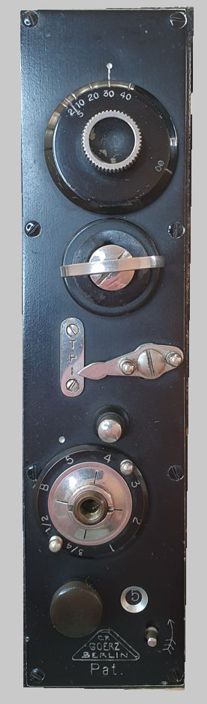
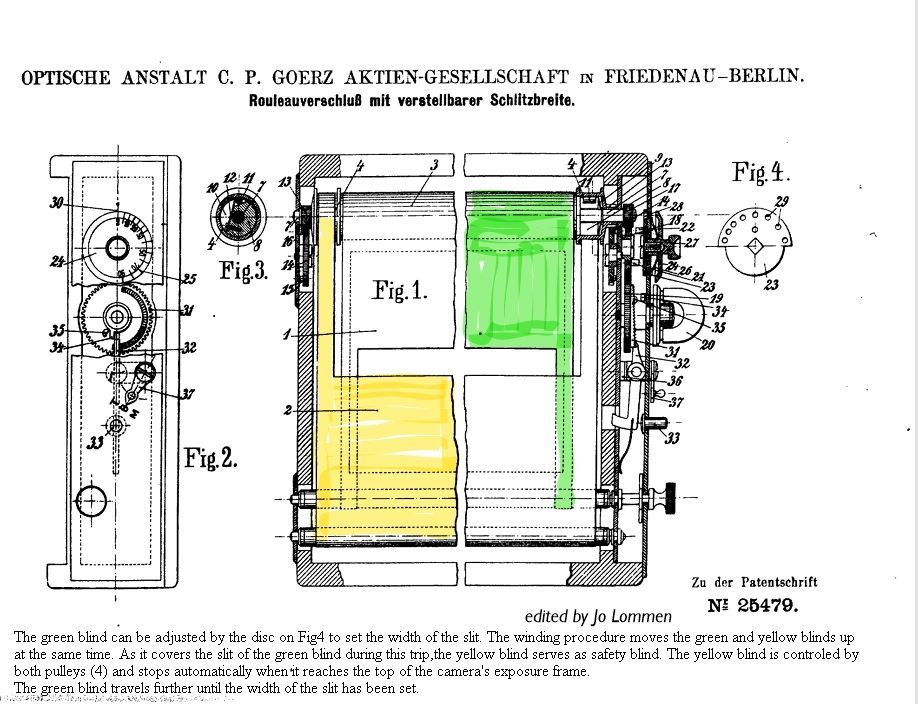
The shutter is a focal-plane shutter that glides directly in front of the plate. It is externally adjustable for time
and instantaneous exposures up to 1/1000 of a second*),
simple bulb exposures, and bulb exposures with an adjustable duration of 1/2 to 5 seconds.
When cocking the shutter, it emains closed, preventing any exposure of the plate even if the dark slide is already withdrawn.
The desired slit width can be adjusted from the outside in millimetres using a scale; once set, the slit retains its width for any number of repetitions.
For bulb and time exposures, the spring that tensions the shutter is automatically released, which prevents vibrations during the exposure.
Despite the exceptional versatility of our shutter,operation is simple and convenient, while remaining solid and durable.
In reality, from the start on and waiting for the key to be wound, the green blind covers the exposure frame completely.
The green blind exist out of an upper blind and a lower blind separated by a gap which is as big as the exposure frame.
Two straps (green) connect both blinds.
Winding the key, the green blind and the yellow blind are being pulled up at the same time.
The green blind pulled up by the shaft and the yellow blind by the pulleys
This works in such a way that
during the winding procedure the exposure frame stays covered.
The green blind stops automatically when the end of the upper blind reaches the shaft.
The green blind is now rolled upon the shaft leaving the gap behind.
At the same time the yellow blind has been pulled up by the straps above the cover of the upper part of the green blind.
During the winding procedure the yellow blind takes over the covering of the exposure gap from the green blind.
The green blind is now rolled upon the shaft leaving its gap behind while the yellow blind covers the gap and the slits of the
The yellow bind waits to be set by the winding key. When reached the previous set position the winding is stopped automatically.
a=To set, press knob inwards and turn to prefered exposure time number do not turn knob without pressing inwards
it would definately ends up with a destroid camera
release the knob in front of the mark.
b= Winding Knob Arrow only Anti Clockwise
c=Setting lever for Time Bulb Instant
d= Release Knob
e=Bulb setting to choose speeds from 1/5 to 1/10 this is no longer relevant due to
perished rubber
f=Speed tension setting
g=slide upwards to neutralise spring tension. You can hear the spring loosing tension
-----------------------------------------------------------------------------------------------------
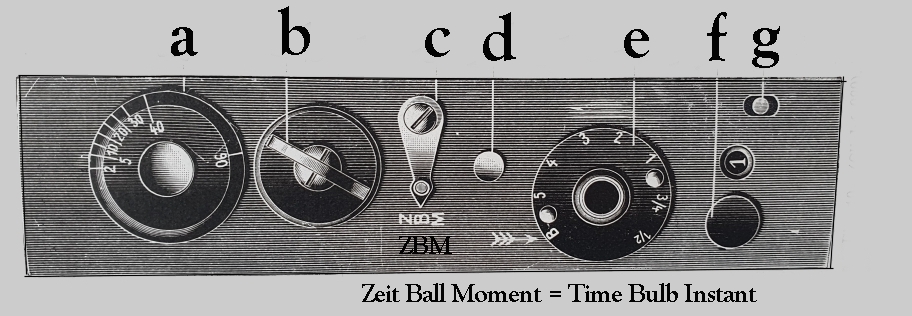
Move pointer C to M, and furthermore set disc a—which indicates the slot width in mm—to the desired slot width
by simultaneously pressing inward and turning.
This means aligning the desired millimetre number opposite the index mark.
Then, pull the shutter open using handle b clockwise
until it hits the stop.
To release the shutter, press once on pin d or on the rubber bulb* that is attached to the centre of valve disc e.
The hard rubber button f serves to increase the tension of the shutter spring, while pin g is used to release
this same spring by hand.
When the shutter is cocked, the slot width can be widened as desired, but the shutter must then be tensioned further by turning handle
b clockwise until the stop.
Turn the winding key until it stops automatically and to make the exposure, press the
release button.
Now the automatic focal plane shutter runs down and stops when the top of the width of the slit uncovers the film exposure frame completely.
The next push on the release knobs bringst the shutter blind alive again and it will drop down to cover the film exposure frame again.
End of the Time exposure.
*) Despite a missing or perished rubber Ball which is unfortunately with almost every still existing vintage camera a fact, here are some indications how the bulb setting works:
Bulb exposures of arbitrary duration.
Move pointer c to B, set disc a to the slot width of 90 mm, and turn valve disc e until B stands opposite the
index mark.
Now, pull the shutter open at b until it hits the stop.
For the release, press and hold pin d or the rubber bulb for as long as you wish to
expose.
When the pressure is released, the shutter closes again.3.
Automatically regulated bulb exposures from
1/2 to 5 seconds.*)
These can only be made using the rubber bulb.
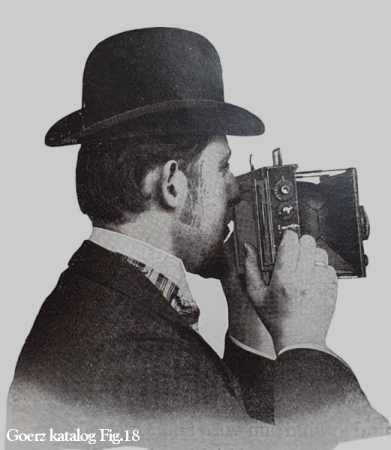
Using Sheet Film
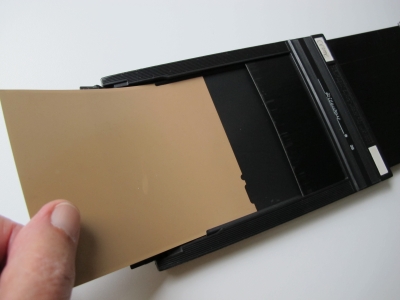
To use them with sheet film just place the sheet film negative with the marks on the right upper site pointing to the top
above the glass or plastic underlay and push the dark slide to close the holder.
The holder's build in blade spring presses the underlay with the sheet film into the right position.
Use the dark room to load and unload the film into the holder.
Visit my help page for loading sheet film.
Sheet film for use in your vintage camera is still available
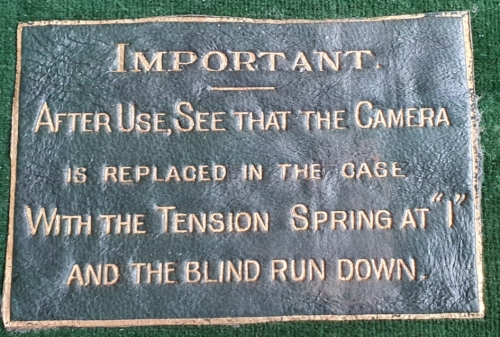
How to store your camera?
Warning tag found inside the original Goerz camera case.
"Set tension spring power at the lowest and blind down."
This message should be taken serious in general for spring powered mechanical tools or apparatus.
Long time storage with spring wound at high level causes a lazy not reliable shutter exposure time.
Back to European cameras
American Press Cameras
Jo Lommen Vintage Cameras